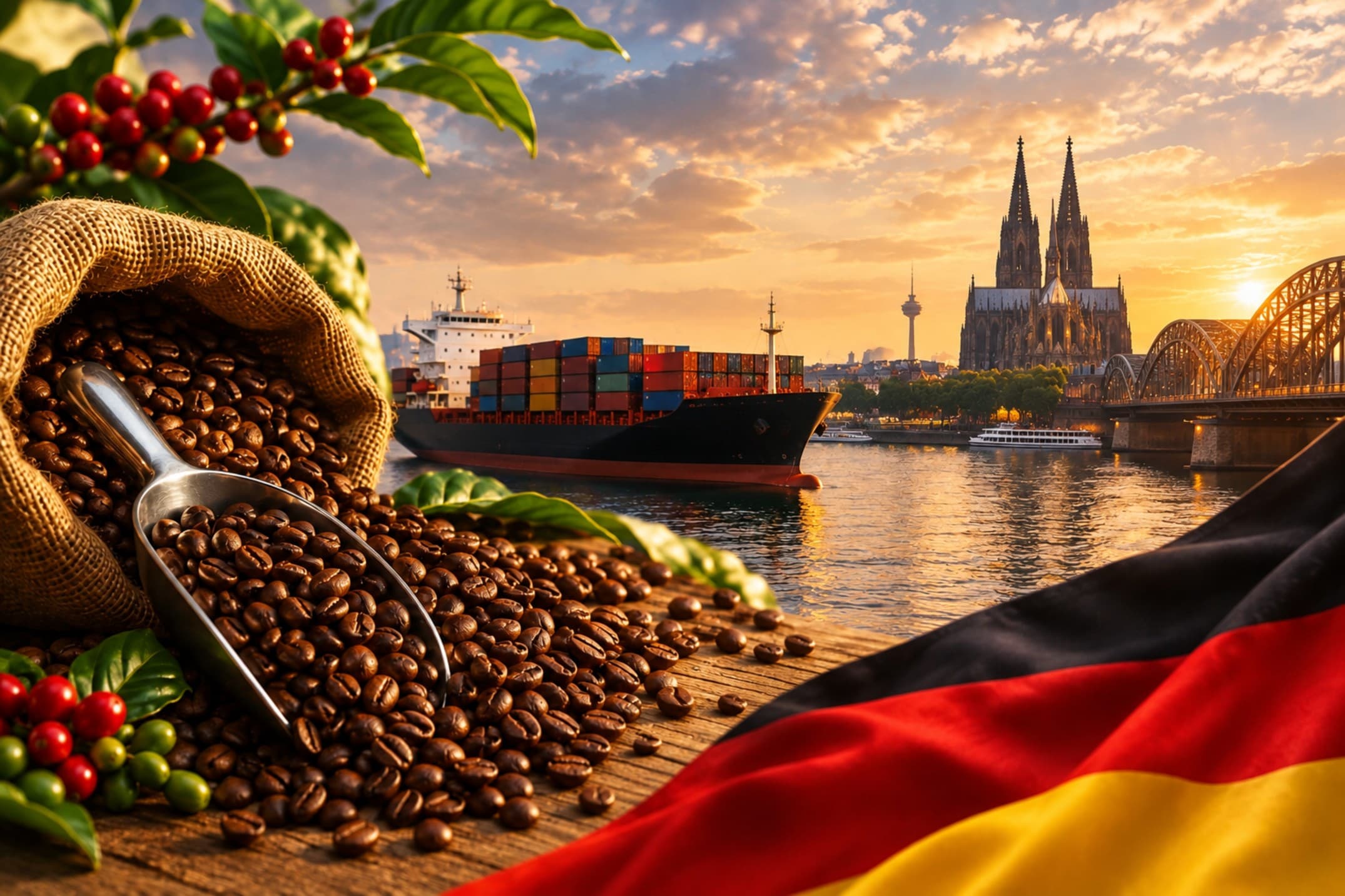
Coffee Shipping India to Germany
Sea freight routes, shipping costs, container options, ports, and logistics best practices for exporting Indian coffee to Germany efficiently and safely.
How to Ship Coffee from India to Germany
The India–Germany coffee route is well-established, with regular shipping lines, experienced freight forwarders, and efficient customs procedures. Understanding shipping options, costs, timelines, and best practices ensures your coffee arrives on time, in good condition, and without costly delays.
This guide walks you through sea freight routes, container options, pricing, ports, Incoterms, customs brokers, and everything needed to move your coffee across oceans smoothly.

Shipping Routes & Sea Timelines
🌍 Primary Route
Indian Loading Ports: Cochin (Kochi) in Kerala is the main coffee export port, followed by Chennai (Madras) in Tamil Nadu. Cochin has dedicated coffee handling infrastructure and is preferred by exporters for faster loading.
German Discharge Ports: Hamburg (world's busiest) is the primary destination. Bremen and Bremerhaven are alternatives for some shipping lines. All have coffee-handling experience and efficient customs procedures.
⏱️ Sea Transit Time
- Cochin to Hamburg:28–32 days
- Cochin to Bremen:29–33 days
- Chennai to Hamburg:26–30 days
ℹ️ Times vary by season (monsoon delays June–Sept) and shipping line schedules. Always add 1–2 days buffer for unexpected delays.
📊 Total Timeline from Order to Delivery
Container Types & Capacity
20-foot Container (20GP)
StandardMost common choice for Indian coffee exports to Germany. Flexible, cost-effective, and easier to manage than 40GP.
- Internal Dimensions:5.9m (L) × 2.35m (W) × 2.39m (H)
- Coffee Capacity:320 bags × 50kg = 16 metric tons
- Or:213 bags × 60kg = 12.8 metric tons
- Cost (Cochin–Hamburg):EUR 800–1,200 depending on season
- Best For:First-time importers, smaller orders
40-foot Container (40GP)
Economy of ScaleDoubles capacity for only 50% higher freight cost. Better cost per unit for large orders.
- Internal Dimensions:12.19m (L) × 2.35m (W) × 2.39m (H)
- Coffee Capacity:640 bags × 50kg = 32 metric tons
- Or:426 bags × 60kg = 25.6 metric tons
- Cost (Cochin–Hamburg):EUR 1,200–1,800 depending on season
- Best For:Bulk importers, commercial roasters
💡 Shipping Economics
For 16–20 metric tons, a 20GP container is optimal. For larger quantities (25+ metric tons), a 40GP becomes more economical per kilogram. Freight forwarders can advise on the best option based on your volume and budget.
Shipping Costs & Landed Price
20GP Container Cost Example
Total Shipping Cost per 20GP:
EUR 1,500–2,400
For 16 metric tons (320 × 50kg bags): EUR 93–150 per metric ton
📊 Cost Factors
- →Seasonality (peak rates June–September)
- →Fuel surcharges (bunker adjustment)
- →Shipping line & vessel availability
- →Port congestion (rare in Hamburg)
- →Currency fluctuations (USD/EUR)
💰 Ways to Optimize
- →Order during low season (Oct–May) for lower rates
- →Negotiate volume discounts (20+ containers/year)
- →Use FOB terms to shop freight forwarders
- →Fill containers to maximum capacity (reduce per-kg cost)
- →Bundle with other commodities if possible
Incoterms: FOB vs. CIF
FOB (Free on Board)
- Seller Responsibility
- Load goods onto vessel at Cochin port
- Buyer Responsibility
- Pays ocean freight & insurance from Cochin to Hamburg
- Risk Transfer
- When goods cross the ship's rail in India
- Price
- Lower — buyer bears freight & insurance
- Best For
- Experienced importers, bulk buyers with logistics setup
✓ Advantages
- • Lower purchase price
- • Buyer controls freight forwarder
- • Buyer shops freight rates independently
✗ Disadvantages
- • Buyer arranges freight & insurance
- • Buyer assumes risk during sea transit
- • More complex documentation
CIF (Cost, Insurance & Freight)
- Seller Responsibility
- Pays ocean freight & insurance to Hamburg
- Buyer Responsibility
- Pays price + freight + insurance; takes possession at Hamburg
- Risk Transfer
- When goods reach Hamburg port
- Price
- Higher — seller covers freight & insurance
- Best For
- First-time importers, smaller orders, risk-averse buyers
✓ Advantages
- • Simpler for buyer — one invoice covers all
- • Seller manages freight & insurance
- • Less risk for buyer during transit
✗ Disadvantages
- • Higher overall price
- • Buyer can't shop freight forwarders
- • Seller insurance terms may not match buyer needs
German Ports & Customs Brokers
🚢 Hamburg Port (Hamburger Hafen)
Europe's largest coffee import hub. World-class handling infrastructure for coffee containers, dedicated customs terminals, and experienced Coffee Brokers (Kaffeemakler) familiar with Indian coffee imports. Estimated 40% of European coffee passes through Hamburg. Fastest clearance times in Germany.
- → Location: Northern Germany (Elbe River)
- → Berths: Multiple deep-water terminals
- → Average dwell time: 2–3 days (fastest)
- → Customs: Zollamt Hamburg (efficient)
Recommended Customs Brokers (Zollmakler):
- • Kaffeemakler Hamburg (specialist)
- • Rhenus (global logistics partner)
- • Geodis / Koehler (coffee specialists)
Tip: Ask Leelaprasad Coffee for referrals — we work with established brokers regularly.
🌊 Bremen Port (Bremenports)
Germany's second-busiest port for coffee. Modern infrastructure, competitive tariffs, and good service. Slightly longer average dwell time than Hamburg but often lower port fees.
- → Location: Northern Germany (Weser River)
- → Average dwell time: 3–4 days
- → Customs: Zollamt Bremen
Top Customs Brokers:
- • Carl Schulze (Bremen)
- • Bremenports Logistics
⚓ Bremerhaven (Container Terminal Bremerhaven)
Germany's deep-water container hub for mega-ships. Newer facilities but slightly further from major German distribution centers than Hamburg. Used by some shipping lines for cost reasons.
- → Location: Lower Saxony (Weser Estuary)
- → Average dwell time: 3–5 days
- → Customs: Zollamt Bremerhaven
Customs & Brokers:
Less specialized for coffee; most importers use Hamburg or Bremen. Bremerhaven brokers can be contacted but less familiar with coffee import nuances.
Packaging & Handling Standards
📦 Bag Standards
Coffee is packed in 50kg or 60kg jute bags with inner moisture-protective PE liners. Bags must be food-grade, sewn closed, and numbered for traceability.
🔲 Stacking & Palletizing
Bags are stacked on wooden pallets (typically 10–12 bags per pallet for 50kg, or 8–10 for 60kg) with proper ventilation and stability. Pallets should be secured with bands to prevent shifting during sea transit.
📋 Container Lining (Optional but Recommended)
A moisture-absorbing lining inside the container protects against condensation and temperature swings during the 30+ day sea journey, especially during monsoon season.
🏷️ Labeling & Identification
Every bag must be labeled with exporter name, origin, coffee variety, weight, and lot number for traceability. Container doors must be sealed with customs seals upon loading.
🌡️ Climate Considerations
Avoid shipping during monsoon season (June–September) if possible — higher humidity and temperature swings risk moisture ingress and mold. Peak quality shipping: October–May.
Major Shipping Lines India → Germany
Maersk
- Frequency:Weekly sailings Cochin–Hamburg
- Transit Time:30 days
- Notes:Largest, most reliable, premium rates
MSC (Mediterranean Shipping)
- Frequency:Bi-weekly Cochin–Hamburg
- Transit Time:31 days
- Notes:Competitive rates, good schedule
CMA CGM
- Frequency:Weekly via transshipment
- Transit Time:32–34 days
- Notes:Often via Middle East hubs
HAPAG-Lloyd
- Frequency:Bi-weekly Cochin–Bremen
- Transit Time:29–31 days
- Notes:German line, efficient
Evergreen
- Frequency:Bi-weekly Cochin–Hamburg
- Transit Time:30–32 days
- Notes:Competitive, good service
ONE (Ocean Network Express)
- Frequency:Weekly sailings
- Transit Time:30–31 days
- Notes:Japanese alliance, reliable
💡 Tip: Freight forwarders (Spediteure) like Rhenus, Geodis, or regional players can negotiate rates with shipping lines. Don't book directly with lines unless you're shipping 10+ containers/year.
Common Shipping Issues & How to Avoid Them
Moisture & Mold in Container
Common Cause: Monsoon humidity, temperature swings between Indian and German climates. Condensation forms inside container.
Mitigation: Use moisture-absorbing liners, avoid monsoon season shipping, ensure good ventilation in palletizing.
Container Damage / Rough Handling
Common Cause: Port equipment damage during loading/unloading, rough seas, stacking pressure. Bags can get crushed or split.
Mitigation: Secure pallets with bands, inspect containers before loading, use damage waiver insurance, have pre-arrival inspection photos.
Schedule Delays & Port Congestion
Common Cause: Vessel mechanical issues, port congestion (rare in Hamburg but possible), weather delays, customs holds.
Mitigation: Build 2–3 day buffer into timeline, use established shipping lines with redundancy, ensure documentation is complete before vessel arrival.
Unexpected Freight Surcharges
Common Cause: Fuel surcharges (bunker adjustment), currency fluctuations, port congestion fees, low-sulphur fuel premium.
Mitigation: Lock in rates in writing with freight forwarder, clarify all surcharges upfront, negotiate annual rate agreements for volume.
Customs Delays in Germany
Common Cause: Missing or incorrect documentation, CHED-PP not pre-notified, weight discrepancies, lab analysis non-compliance.
Mitigation: Verify all documents match before shipment, ensure CHED-PP pre-notification 1 day before arrival, arrange lab analysis in advance.
Package Leakage / Spillage
Common Cause: Jute bags not properly sealed, torn bags, rough port handling, moisture ingress.
Mitigation: Use high-quality food-grade jute bags, triple-check sealing at origin, inspect loading in India, use inner PE liners.
Shipping Checklist
☐ Coffee graded, tested, and certified for export quality?
☐ Lab analysis (pesticides, mycotoxins) completed & compliant?
☐ Phytosanitary Certificate arranged (3–5 days in advance)?
☐ Commercial Invoice and Packing List finalized?
☐ Shipping line & container booking confirmed?
☐ Freight forwarder selected (FOB) or CIF agreement finalized?
☐ Incoterms agreed upon in writing?
☐ Bags sealed, labeled, and palletized per standards?
☐ Container loading supervised or pre-arrival inspected?
☐ Bill of Lading (3 originals) to be sent via DHL/FedEx?
☐ German customs broker engaged for pre-notification?
☐ Insurance arranged if CIF terms (110% invoice value)?
☐ All scanned documents sent to customs broker in advance?
☐ German warehouse ready (15–20°C, 60–65% RH)?
Shipping & Logistics — FAQs
How long does it take to ship coffee from India to Germany?
Sea freight takes 28–35 days from Cochin/Chennai to Hamburg. Total time from order confirmation to cargo release in Germany: 6–8 weeks including processing, documentation, and customs clearance.
What container size should I order for coffee?
20GP (320 × 50kg bags = 16 MT) is standard for smaller orders and first-time importers. 40GP (640 × 50kg bags = 32 MT) is more economical for bulk orders 25+ MT. 20GP offers better flexibility.
What are the shipping costs from India to Germany?
Ocean freight: EUR 800–1,500 per 20GP container depending on season. Total landed cost including documentation and customs: EUR 1,500–2,400 per 20GP, or EUR 93–150 per metric ton.
What is the difference between FOB and CIF?
FOB: Buyer arranges and pays for freight/insurance from Indian port (cheaper, more control). CIF: Seller pays for freight and insurance to Germany (simpler for buyer, higher cost). CIF is recommended for first-time importers.
Which German port is best for coffee?
Hamburg is the world's largest coffee hub with fastest clearance (2–3 days). Bremen is a good alternative with lower port fees. Bremerhaven is least specialized for coffee.
Do I need marine insurance for coffee shipments?
Under CIF terms, it's included. Under FOB, strongly recommended (0.5–1.5% of value). Standard coverage: 110% of invoice value, ICC Clause C.
Ready to Ship Your Coffee to Germany?
Leelaprasad Coffee handles everything: quality certification, documentation, freight forwarding coordination, and customs broker liaison. We have 20+ years of experience shipping coffee to Germany without delays or complications.
Questions About Shipping Coffee to Germany?
Email: export@leelaprasadcoffee.com | Phone: +91-96869 95189
Monday–Friday · 9:00 AM – 6:00 PM IST · Response within 24 hours