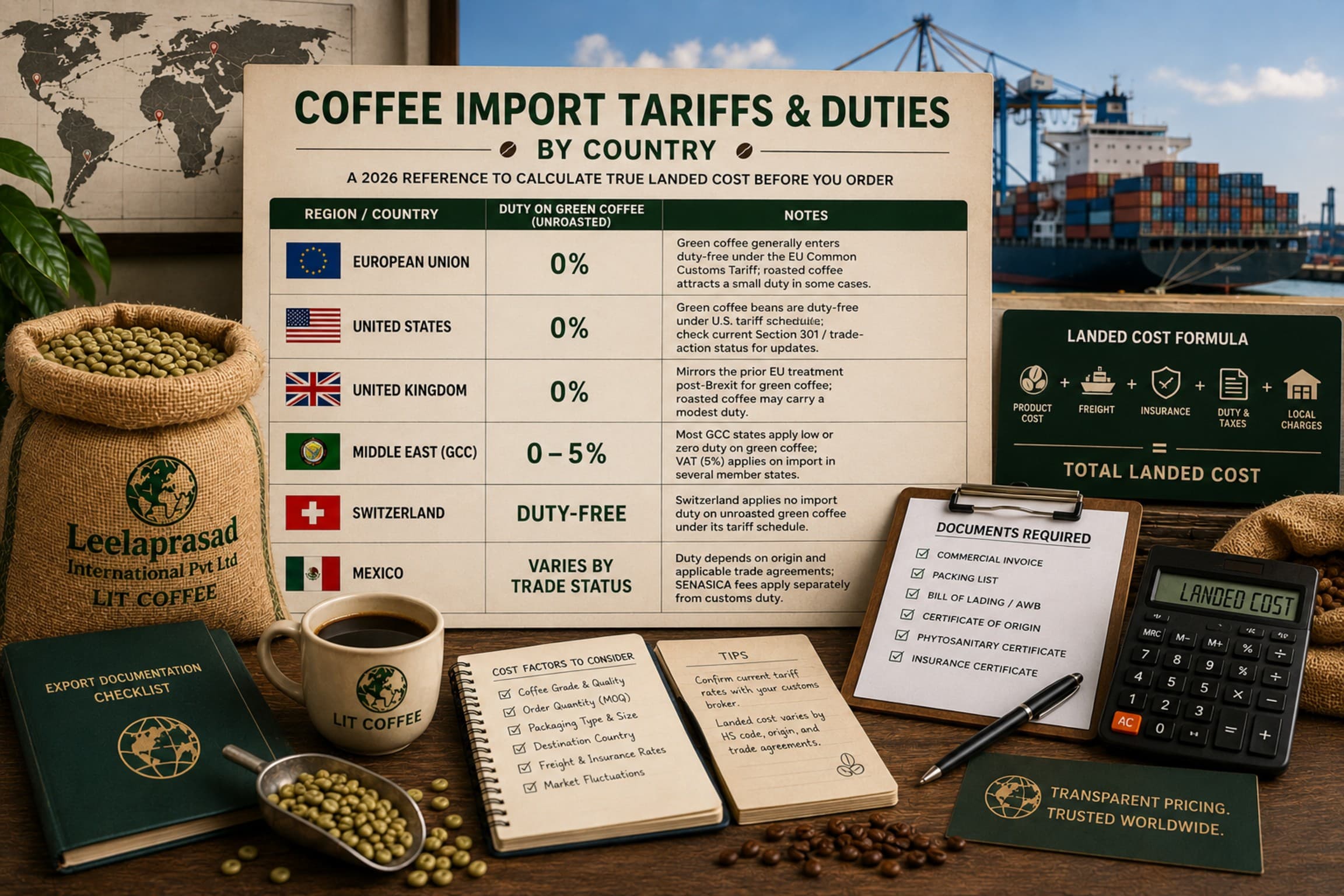
Global coffee import and shipping logistics

Coffee Trade Guide · Updated 2026

Coffee Import Duty by Country

Compare the customs, tariff and tax factors that affect the landed cost of importing coffee from India into major global markets.

2026 tariff note: customs rates and trade measures can change. Use the official tariff database for the destination country and the exact product classification before quoting a landed cost or placing a purchase order.

HS heading

0901

Coffee classification begins at HS heading 0901.

Green coffee

Check exact code

Duty depends on destination, origin and tariff line.

Roasted coffee

Different line

Roasted and processed products can have different treatment.

Landed cost

More than duty

Freight, taxes, clearance and inland delivery also matter.

Before you compare suppliers

The cheapest FOB price is not always the cheapest landed cost

A coffee buyer should compare the full cost of getting the shipment into the warehouse, not only the supplier's FOB or CIF quotation. Customs duty is one component; freight, insurance, VAT or other import taxes, port charges, customs brokerage and inland transport can also change the final cost.

This guide gives you the framework for comparing markets while avoiding outdated blanket tariff claims. For an actual shipment, verify the exact tariff line, origin and destination with the relevant customs authority or broker.

Coffee import documentation and customs calculation

2026 reference

Coffee import duty by major market

The table is intentionally framed around what a buyer should verify rather than presenting potentially stale rates as permanent facts.

Market

European Union

Classification

HS 0901 / EU CN & TARIC

Duty

Verify current TARIC

The EU's TARIC database provides the current customs measures. Do not quote a permanent 0% rate without checking the exact CN code, origin and measure.

Check EU TARIC →

Market

United States

Classification

HTS heading 0901

Duty

Verify current HTS

The U.S. Harmonized Tariff Schedule is updated through official revisions. Check the exact HTS line and any additional trade measures applicable to the shipment.

Check U.S. HTS →

Market

United Kingdom

Classification

UK Trade Tariff

Duty

Verify current tariff

The UK uses its own tariff system after Brexit. Check the live UK Trade Tariff for the product code and origin.

Check UK tariff →

Market

Switzerland

Classification

Swiss customs tariff

Duty

Verify current tariff

Swiss tariff treatment is separate from the EU. Confirm the current Swiss tariff line and any applicable charges for the exact coffee product.

Check Swiss tariff →

Market

GCC / Middle East

Classification

National / GCC tariff

Duty

Country-specific

Rates and import taxes differ between Gulf markets. Check the destination country's current customs and VAT rules.

Check destination →

Market

Mexico

Classification

Mexican tariff schedule

Duty

Origin-dependent

The applicable rate can depend on classification, origin and trade arrangements. Verify with Mexican customs or the importer's broker.

Confirm with broker →

For European buyers

Use TARIC for the actual EU duty calculation

The European Commission describes TARIC as the EU's integrated tariff database containing measures under the Common Customs Tariff and related commercial and agricultural legislation. TARIC data is transmitted daily to national administrations, making it the right place to verify current EU measures rather than relying on an old static table.

Open EU TARIC

United States

Check the current HTS line before quoting U.S. landed cost

U.S. tariff treatment is determined through the Harmonized Tariff Schedule. The schedule is updated through official revisions, so a historical “0% coffee duty” statement should not be treated as a complete 2026 landed-cost calculation.

Check the exact HTS classification and any additional trade measures that may apply to the origin and product.

Open U.S. HTS

What to confirm for a U.S. shipment

  • Exact HTS number
  • Green, roasted or processed coffee
  • Country of origin
  • Current general duty rate
  • Any additional tariff or trade measure
  • Import fees, broker charges and inland transport

Landed cost

How to calculate the real cost of imported coffee

Use this structure when comparing an Indian supplier's quote against another origin or another Incoterm.

1

Coffee purchase price

The agreed supplier price under the contract and Incoterm.

2

International freight

Ocean, air or other carriage from the export point to the destination.

3

Insurance

Include where required or purchased under the agreed commercial terms.

4

Import duty

Calculated from the applicable tariff classification, origin and customs value.

5

Import VAT / taxes

Destination-specific taxes applied under local rules.

6

Customs & port charges

Brokerage, handling, documentation, terminal and related charges.

7

Inland delivery

Transport from the destination port or border to the buyer's warehouse.

Landed cost = product cost + freight + insurance + import duty + import taxes + clearance/port costs + inland delivery

The exact calculation depends on the destination country's tax rules and the Incoterm used in the purchase contract.

Buying from India

Origin documentation can affect the duty you actually pay

The tariff outcome can depend on the country of origin and whether a preferential arrangement is available for the specific product. That is why a buyer should provide the exporter and customs broker with the correct origin details before calculating the commercial landed cost.

For Indian coffee, keep the product description, tariff classification, origin evidence and shipment documents consistent across the commercial and customs paperwork.

Explore Indian Coffee Export
Indian coffee harvesting and origin supply chain

European compliance

Tariff is only one part of the 2026 EU import picture

Coffee is within the scope of the EU Deforestation Regulation (EUDR). The European Commission's current timetable says the Regulation applies from 30 December 2026 for large and medium operators and certain micro and small operators, and from 30 June 2027 for other micro and small operators.

Buyers sourcing Indian coffee for Europe should therefore plan supply-chain traceability and due-diligence processes alongside tariff and customs planning.

Read the India-to-Europe Import Guide

FAQ

Coffee import duty FAQs

What HS code is used for coffee?

Coffee is classified under HS heading 0901. The exact national or regional tariff subdivision depends on the product, such as green or roasted coffee and whether it is decaffeinated. Importers should confirm the applicable CN, TARIC, HTS or national tariff code before calculating duty.

Is green coffee duty-free in every country?

No. Duty depends on the destination, exact tariff classification, country of origin, trade agreement and any preferential programme. A broad global 0% statement is not reliable enough for a commercial landed-cost calculation.

What is the difference between import duty and VAT?

Import duty is a customs charge determined by the applicable tariff measure. VAT or another consumption tax is a separate tax that can apply to the import transaction. The exact tax base and rate depend on the destination country.

Does importing from India change the duty rate?

It can. The destination may apply a standard tariff, a preferential tariff or another trade measure based on origin. Importers should check the current tariff database for India as the country of origin and retain the required origin evidence.

How do I calculate the landed cost of imported coffee?

Start with the agreed product price, then account for international freight, insurance where applicable, import duty, import VAT or other taxes, customs clearance, port charges, inland transport and other destination costs. The exact calculation depends on the Incoterm and destination.

How often should coffee tariff information be checked?

Before each significant purchase order or shipment. Tariff databases and trade measures can change, so use the current official customs source rather than relying on an old article or static rate table.

Source Indian coffee

Need help estimating your coffee import cost?

Send our export team your destination country, coffee type, approximate quantity and preferred delivery terms. We can discuss the product and commercial information needed for your import calculation.

LIT COFFEE — Leelaprasad International Pvt Ltd

Export enquiries: export@leelaprasadcoffee.com · +91-96869 95189

Call us nowWhatsApp us

Looking for retail packs instead of bulk export? Lit Coffee has you covered.

Shop Now

Partner with Leelaprasad International Pvt Ltd for Trusted, Certified Indian Coffee Exports

Join global partners who choose Lit Coffee for exceptional quality, traceability, and sustainability—rooted in India's finest coffee heritage.

© 2026 Leelaprasad International Pvt Ltd. All rights reserved.

Looking for retail packs instead of bulk export? Lit Coffee has you covered.

Shop Now