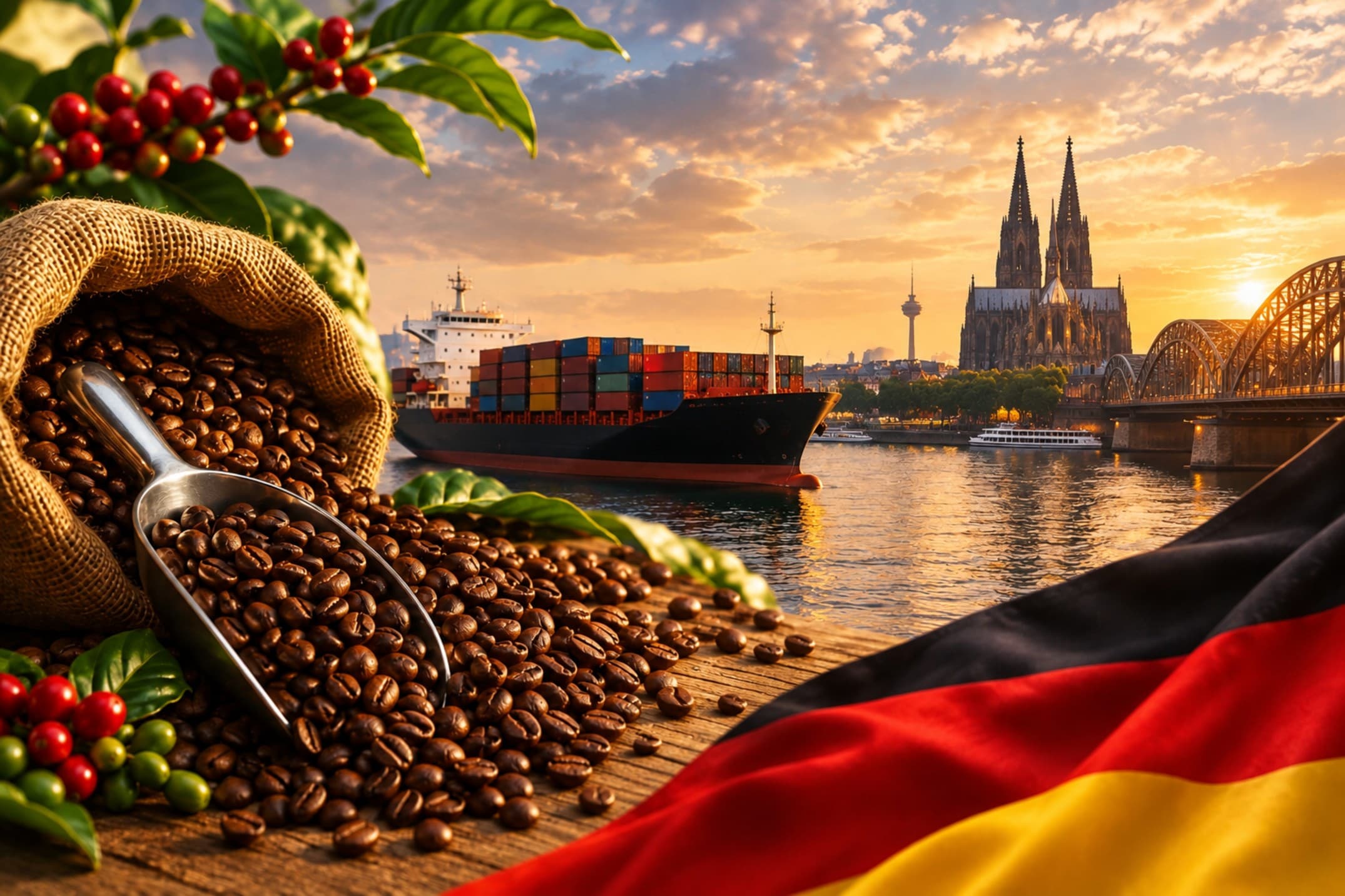
Coffee Import Requirements for Germany
Phytosanitary certificates, EU food safety regulations, customs procedures, and labeling standards for importing Indian coffee into Germany. Everything you need to clear customs without delays.
What Are the Legal Requirements?
Coffee imports into Germany and the EU are governed by plant health regulations, food safety standards, and customs procedures. Understanding these requirements upfront protects you from delays, shipment rejections, and penalties.
This guide walks you through every legal requirement, certification, and best practice to ensure your Indian coffee arrives in Germany in full compliance with EU law and without customs holds.
Phytosanitary Certificate
📋 What Is It?
An official document issued by India's Plant Quarantine Division (NPPO) certifying that coffee has been inspected and is free from regulated pests, plant diseases, and biological contaminants. This certificate is required for all coffee entering the EU.
Validity: 14 days from date of issue. Must physically accompany the shipment during transit.
✓ Essential Content
- •Exporter name and issuing authority (NPPO India)
- •Detailed commodity description (e.g., 'Green Coffee Beans, Arabica')
- •Total quantity and number of packages
- •Official stamp and signature from Indian agricultural authority
- •Declaration of compliance with international phytosanitary standards
⚠️ Without Phytosanitary Certificate
Shipment is rejected at EU border (Zollamt / Customs). Risk of confiscation, administrative penalties up to EUR 1,000–5,000, and total loss of the shipment.
HS Codes & Tariff Classification
The Harmonized System (HS) code is critical for German customs clearance. Using the wrong code results in incorrect tariffs, customs penalties, and processing delays.
0901.11 — Green Arabica Coffee (Not Roasted)
Premium quality Arabica beans; zero EU tariff under GSP preferential trade with India.
0901.12 — Green Robusta Coffee (Not Roasted)
Commercial-grade Robusta for blends and filter; zero EU tariff.
0901.21 — Roasted Arabica Coffee
If roasting occurred before import into Germany.
0901.22 — Roasted Robusta Coffee
If roasting occurred before import into Germany.
0901.90 — Coffee Substitutes / Blends
Blends with less than 95% coffee content. Risk of misclassification — verify with customs.
💡 Tip for German Importers
Always confirm the correct HS code with your customs broker (Zollmakler) before submitting the SAD (Single Administrative Document). Ask your Indian supplier to specify the HS code on the commercial invoice.
EU Food Safety Regulations
Pesticide Residues (Reg. 396/2005)
- →Maximum Residue Limits (MRL) vary per pesticide
- →Green coffee must comply with EU MRL thresholds
- →Request supplier lab analysis before ordering
- →Analysis cost: EUR 200–500 per sample
Mycotoxins (Reg. 1881/2006)
- →Total aflatoxin: max 5 µg/kg
- →Ochratoxin A: max 5 µg/kg for green coffee
- →Laboratory analysis mandatory from accredited lab
- →Non-compliant shipments can be rejected or destroyed
Additives & Contaminants
- →No chemical additives permitted in pure green coffee
- →No EU-banned pesticides (e.g., DDT, lindane)
- →Absence of heavy metals (Pb, Cd, Hg)
- →Pre-export quality control required
Traceability (Reg. 178/2002)
- →Every batch must be traceable from origin
- →Record supplier, harvest date, and shipping info
- →Retain documentation for minimum 3 years
- →Essential if product recall is needed
Recommended Certifications (Not Legally Required)
FSSC 22000
Food Safety System Certification. Not mandatory by law, but required by most German distributors, retail chains, and large importers. Covers hygiene, quality control, and traceability.
Estimated cost: EUR 2,000–5,000
ISO 9001:2015
Quality Management System. Demonstrates that the supplier operates with documented, controlled processes. Highly valued by German buyers as a sign of operational reliability.
Estimated cost: EUR 1,500–4,000
Organic Certification (Bio)
If coffee is grown without synthetic pesticides or chemical fertilizers per IFOAM standards. Significantly increases market value in the German specialty and health-conscious segment.
Estimated cost: EUR 3,000–8,000/year
IFS Food Standard
International Featured Standards for food safety. Alternative to FSSC 22000. Required by some European importers and retail customers. Covers hygiene and safety.
Estimated cost: EUR 2,000–6,000
Fair Trade / Rainforest Alliance
Ethical and sustainability certifications. Don't affect legal compliance but increase commercial appeal in premium German markets and with environmentally conscious buyers.
Estimated cost: EUR 500–3,000
SCA Cupping Analysis
Specialty Coffee Association sensory evaluation. For specialty coffee and premium blends. Not required but highly valued by German specialty roasters.
Estimated cost: EUR 200–800 per sample

German & EU Labeling Standards
If you import green coffee and re-package it for resale in Germany, packaging labels must comply with German food labeling law (LMIV – Lebensmittelinformationsverordnung, based on EU Reg. 1169/2011).
Font minimum 1.2 mm. German language mandatory for consumer-facing labels.
Storage Requirements in Germany
🌡️ Temperature
Ideal: 15–20°C
Green coffee maintains quality at cool, stable temperature.
Maximum: 25°C
Above this, coffee risks degradation and flavor loss.
Avoid: Temperature Shock
Rapid swings compromise quality.
💧 Relative Humidity
Ideal: 60–65% RH
Optimal for preserving bean moisture and aroma.
Minimum: 55% RH
Below this, coffee becomes brittle and loses flavor.
Maximum: 70% RH
Above, risk of mold and aflatoxin development.
📦 Packaging & Warehouse Storage
- Bags: Natural jute or food-grade PE. Avoid non-certified plastics.
- Shipping Boxes: Multi-layer cartons with moisture barrier. Check integrity monthly.
- Ventilation: Warehouse must be well-ventilated, odor-free, and pest-proof.
- Distance from Chemicals: Keep coffee at least 2 meters from pesticides, perfumes, or solvents.
- Shelf Life: Green coffee retains quality 6–12 months if stored correctly.
Import Procedures for Germany
ENS (Entry Summary Declaration)
Mandatory pre-arrival notification for all shipments entering the EU. Submitted by the shipping line or customs broker at least 24 hours before port arrival. Allows German customs (Zollamt) to conduct prior risk analysis.
CHED-PP (Plant Health Entry Certificate via TRACES NT)
For coffee, a plant product subject to EU phytosanitary controls. Must be pre-notified via TRACES NT to the Border Inspection Post (BIP) at the German port (Hamburg, Bremen, or Bremerhaven typically) at least 1 business day before arrival.
SAD / Customs Declaration
The Single Administrative Document (SAD) is the formal customs declaration submitted by your customs broker upon arrival in Germany. It determines tariff calculation, import VAT (19%), and any applicable duties.
Zollabfertigung (Customs Clearance)
At the port of entry (Hamburg), customs inspects documentation and performs physical/analytical checks per routine or intensified inspection frequency. Green coffee from India is classified as high-risk for aflatoxins, so expect 100% documentary checks and frequent physical/lab sampling.
Transport & Logistics Compliance
Ensure containers are clean and properly sealed. Bill of Lading must match commercial invoice exactly in weight, description, and HS code. Any discrepancy causes a customs hold.
Tariff & VAT Calculation
Green coffee (0901.11/0901.12) = 0% EU tariff. Roasted (0901.21/0901.22) = 8%. Import VAT = 19% of landed cost. Tariffs are waived, but VAT is recoverable if you're a registered importer/business.
Pre-Order Compliance Checklist
☐ Supplier has FSSC 22000 or equivalent certification?
☐ Supplier will provide valid Phytosanitary Certificate?
☐ Pesticide residue analysis performed and complies with EU limits?
☐ Mycotoxin analysis (aflatoxin, ochratoxin) confirmed at EU threshold?
☐ Commercial documentation (Invoice, Packing List) prepared?
☐ Certificate of Origin available for GSP tariff benefits?
☐ HS code confirmed as correct (0901.11 or 0901.12 for green)?
☐ Sea transport insured (if CIF terms)?
☐ German customs broker / Zollmakler engaged?
☐ German warehouse ready (15–20°C, 60–65% RH)?
☐ Labels prepared in German for re-packaged coffee?
☐ VAT and tariff costs budgeted (0% tariff + 19% VAT on landed cost)?
Coffee Import Requirements — Frequently Asked Questions
What are the minimum requirements to import coffee into Germany?
Phytosanitary Certificate, Certificate of Origin, correct HS code classification (0901.11/0901.12 for green), complete commercial documentation, compliance with EU food safety limits on pesticide residues and mycotoxins (aflatoxin ≤ 5 µg/kg, Ochratoxin A ≤ 5 µg/kg).
Does green coffee have different tariffs than roasted coffee in Germany?
Yes. Green coffee (HS 0901.11/0901.12) carries 0% EU tariff. Roasted coffee (HS 0901.21/0901.22) carries 8% tariff. Both require Phytosanitary Certificates and must be pre-notified via CHED-PP.
Is FSSC 22000 certification mandatory for coffee imports to Germany?
Not legally mandatory by EU regulation. However, it is strongly recommended and is required by the vast majority of German importers, distributors, retail chains (Edeka, Rewe), and commercial customers.
What are the EU mycotoxin limits for coffee?
Total aflatoxin maximum 5 µg/kg, Ochratoxin A maximum 5 µg/kg for green coffee. Non-compliance results in shipment rejection or destruction at importer's expense.
Do I need to re-label imported coffee if I resell it in Germany?
Yes. Labels must be in German with legible font (minimum 1.2 mm). Required information: product name, net weight, country of origin, ingredients, best-before date, importer name and address in Germany, batch number.
What is CHED-PP and is it required for coffee to Germany?
The Common Health Entry Document (Plants & Plant Products) is the EU plant health certification for all coffee entering EU borders. It must be pre-notified via TRACES NT to the Border Inspection Post (Grenzübergangsstelle) at least 1 business day before arrival.
Want Compliant Coffee Imports to Germany?
Leelaprasad Coffee provides full compliance support: Phytosanitary Certificates, lab analyses, Certificates of Origin, and all documentation needed for German customs clearance. No delays, no rejections.
Questions About Coffee Import Requirements for Germany?
Email: export@leelaprasadcoffee.com | Phone: +91-96869 95189
Monday–Friday · 9:00 AM – 6:00 PM IST · Response within 24 hours